Class-based marriage prohibition
The House of Bernarda AlbaThe Class-based marriage prohibition is Bernarda Alba’s refusal to allow her daughter Martirio to marry Enrique Humanes because his father was a farmhand. The rule makes social rank an explicit boundary on marriage and helps explain why the daughters’ romantic prospects are governed not simply by personal attachment but by family status, inheritance, and Bernarda’s command.
The prohibition and its stated rationale
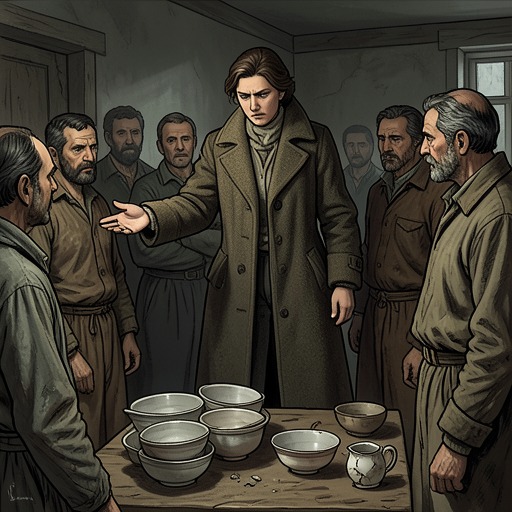
Poncia confronts Bernarda with a specific past decision: Martirio was inclined to fall in love, but Bernarda had prevented her from marrying Enrique Humanes. On the very day he was expected at Martirio’s window, Bernarda sent word that he should not come. When Poncia asks why the match was forbidden, Bernarda answers that she would make the same decision again and insists that her blood will not mix with the Humanes family’s; the decisive reason she gives is that Enrique’s father was a farmhand.
That exchange makes the rule more than an abstract preference for social similarity. Bernarda asserts the authority to determine which families are acceptable to hers, and she treats a man’s parentage and occupation as grounds for excluding him. Her certainty also reveals that the prohibition is not a temporary obstacle awaiting negotiation: she declares that she would repeat it a thousand times.
Marriage, property, and household status
The ban operates in a household where marriage prospects are already entangled with money. The sisters observe that Angustias is the only rich daughter because she has her father’s money, and they suspect that Pepe el Romano is pursuing her for that reason. Their discussion contrasts the appeal of Angustias’s inheritance with their view that he might more naturally court younger sisters such as Amelia or Adela. Marriage therefore appears both as a personal relationship and as a route shaped by property and social position.
The inheritance also creates tension within the family: Antonio María Benavides left Angustias substantially more than his four natural daughters. The commentary raises, without resolving, the possibility that the unequal bequest reflects a concealed closeness between him and Angustias, and asks whether Bernarda suspects it. Against this background, Bernarda’s refusal of Martirio’s match shows how family status and inheritance can shape which relationships are permitted, while secrets and unequal treatment intensify household suspicion.
A village order enforced through reputation
The prohibition belongs to a wider social order in which men and women have unequal freedom, and women’s domestic role is reinforced by expectations of marriage and family respectability. Rural customs represented in the play include long mourning, sewing and embroidery by the daughters, and the prospect of spinsterhood or an arranged, loveless marriage. The community’s gossip also makes private decisions matters of public standing: quarrels over land and inheritance become common knowledge, while sexual scandal can damage a family’s name.
The play sets this informal social discipline beside a history of formal law without presenting Bernarda’s marriage ban as a legal rule. The commentary notes that Spain’s 1870 Penal Code allowed a husband to defend his honour with blood in specified circumstances involving adultery or sexual assault, and that the provision was not abolished until 1963. The play does not depict that precise legal situation; rather, the comparison clarifies the larger historical force of honour-based thinking. Bernarda’s class boundary is enforced inside the family, while the village’s reputation code and the threat of collective punishment extend social control beyond it.
Dramatic significance
Poncia’s challenge gives the marriage prohibition a direct causal place in the household conflict: she argues that Bernarda has not allowed her daughters freedom and cites Martirio’s blocked marriage as evidence. Bernarda’s reply confirms that class prejudice is not incidental to her authority but one of its operating principles. The daughters’ constrained choices, the competition surrounding Angustias’s wealth, and the community’s scrutiny all belong to the same structure, in which marriage can determine status while a family’s claims to honour limit who may choose it.
The rule also sharpens the play’s contrast between appearance and concealed realities. Bernarda publicly defends family rank and reputation, yet the household is marked by unequal inheritance, resentment, and secrets. Her insistence on keeping the family’s name intact does not remove conflict; it helps create the conditions in which choices and grievances remain constrained and unspoken.